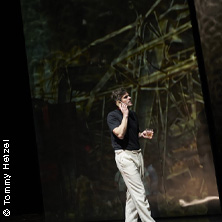
At the beginning of the artistic direction of Patricia Nickel-Dönicke, twelve directors of this and the following season will bring to the stage together with the entire ensemble and the newly founded city ensemble "Der aufhaltsame Aufstieg des Arturo Ui". Seventy years after his death, Brecht still influences contemporary forms of theater. Famous worldwide for his alienation effects, as well as for songs, narrative comments, dance, puppetry, and film, the complexity of Brecht's work will be re-examined at the beginning of the season.
And which play is better suited for these times than "Der aufhaltsame Aufstieg des Arturo Ui"? During the rampant economic crisis in Chicago, the small-time crook Arturo Ui enters the milieu of the vegetable dealers. He guarantees the "Cauliflower Trust" through a dubious business model the preservation of their income, thus gaining access to the city council and the broader circles of the Chicago political elite. Once united in shady dealings, the vegetable dealers must watch as Ui gradually establishes the law of the stronger on the streets of Chicago as well as in the political day-to-day business. Driven by his greed for power as well as by his insatiable gangster colleagues, Chicago soon becomes too small for Ui, and he discovers in the profitability of war the ideal export business.
Brecht's historical farce meticulously reconstructs the mechanisms and patterns through which fascist ideologies consume a state and its civil society. At the end of the play, in a historical parallel to the annexation of Austria in 1938, stands the ultimate break with international law. The clearer and more familiar the individual stages on Ui's path appear, the more pressing is the question: Why does the middle of a society stand still and allow these developments to happen? Does it secretly believe it can profit from the rise of a gangster?
All over the world, power-hungry narcissists are becoming politicians like in Brecht's "Arturo Ui", art and press are experiencing attacks on their freedom believed to be overcome, and international manners from the gangster era of the last century are becoming established. Also in Europe, the questions become more urgent about how the rise of anti-democratic forces can still be halted. Therefore, the collective engagement with Brecht's template is also a positioning for togetherness, without which democratic coexistence cannot be resilient.

 Hallo, ich bin Maya.