Dauer: 1 Stunde 45 Minuten (Pause nach dem ersten Akt)Musik: Richard Rodgers (1902−1979)
Libretto: Oscar Hammerstein II (1895−1960)
Buch: Howard Lindsay und Russell Crouse nach „The Story of the Trapp Family Singers” von Maria von Trapp
Uraufführung: New York, 16.11.1959
basierend auf dem Broadway Musical
In englischer Sprache mit Erläuterungen auf Deutsch, Italienisch, Französisch, Spanisch, Japanisch
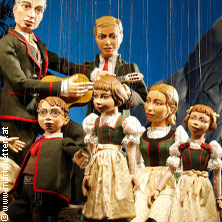
InhaltDas Broadway-Musical und die weltberühmte Verfilmung mit Julie Andrews stehen Pate für die schwungvolle musikalische Geschichte über das Schicksal des Baron von Trapp und seinen sieben Kindern.
BesetzungFassung für das Salzburger Marionettentheater und Regie: Richard Hamburger
Bühnenbild und Licht: Chris Barreca
Puppen- und Kostümentwürfe: Anita Yavich
Sound Design: David Budries
Musikalische Leitung: David Rosenmeyer
Dramaturgie: Melissa Cooper
Technik: Alexander Proschek
Marionettenspieler:innen: Philippe Brunner, Anne-Lise Droin, Pierre Droin, Vladimir Fediakov, Edouard Funck, Heide Hölzl, Maximilian Kiener, Marion Mayer, Emanuel Paulus, Philipp Schmidt, Eva Wiener, Ursula Winzer
Sänger:innen, Sprecher:innen: Kelsey Fowler, Joy Franz, Jenn Gambatese, Kylie Goldstein, Matthew Gumley, Jonathan Groff, Betsy Hogg, Jeanne Lehman, Michael McCarty, Crista Moore, Christiane Noll, Martin Vidnovic, Jennifer Hope Wills, Bill Youmans
Weitere InformationenIstropolis Philharmonisches Orchester
Dirigent: Larry Blank
Orchestrierung: Robert Russell Bennett
Chorarrangements: Trude Rittmann
Besonderer Dank an: Ted Chapin, Timothy Crouse, Bert Fink, Bruce Pomahac
Weitere Informationen über „The Sound of Music“ und Musicals von Rodgers & Hammerstein unter
http://www.rnh.comAufführung in Arrangement mit Josef Weinberger Ltd., London für The Rodgers and Hammerstein Organization, New York
Lizenzgeber für Österreich: Josef Weinberger Wien GmbH
Premiere: Dallas, 2.11.2007Sämtliche Marionetten sowie die gesamte Ausstattung wurden in den Werkstätten des Salzburger Marionettentheaters hergestellt.

 Hallo, ich bin Maya.